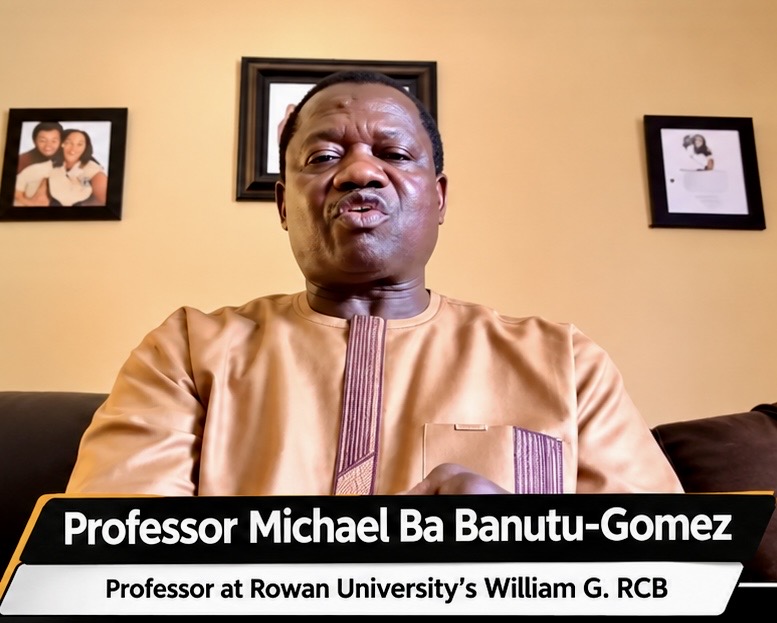
Dr. Michael Banutu-Gomez, a Gambian-born management professor at Rowan University’s William G. Rohrer College of Business in the United States, has urged Gambians to confront the reality of ethnic politics ahead of the country’s December elections.
Speaking with Sainey Marenah on The Final Take with MK on Alkamba Times, the academic addressed the theme “Ethnic Mobilization and Its Risks: What It Means for Democracy in The Gambia’s December Elections.”
Banutu-Gomez said such conversations rarely occur in The Gambia because of a preference for maslaha — avoiding conflict — and the belief that “silence is golden.” He welcomed the fact that figures including himself and Father Mansaly are now speaking openly. “We have what we call a safety face in politics,” he said. “You see the reality, but you pretend it does not exist.” His personal motto, he added, is that when people see reality and refuse to face it, the problem never disappears. Instead, it reappears in different forms that further damage society and deepen divisions between ethnic groups.
He insisted on “calling a spade a spade,” acknowledging that marginalization exists. At the same time, he cautioned against allowing political parties to exploit those grievances. “Political parties are only interested in scoring a point,” he said. “They will come and go.” Once a party that has mobilized an ethnic group leaves power, he argued, the incoming government often views that group differently and treats it accordingly. “That’s the danger I’m calling for.”
Banutu-Gomez pointed to historical examples, including land disputes and tensions over alkalo leadership that once affected Mandinka communities. In those cases, he recalled, political parties and the government intervened to stop the conflicts. The lesson, he said, is clear: if people genuinely care about an ethnic group, they must stand up for the real issues facing that group rather than allowing parties to use it for short-term advantage. Likewise, anyone who cares about the country must address the challenges confronting the nation as a whole.
He stressed that national development must benefit every community rather than targeting or exploiting the perceived weakness of any one group. “The country needs ways of developing every ethnic group,” he said. Banutu-Gomez named the Mandinka, Wollof, Karoneka, Jola, and Mankanya communities, among others, urging them all to “wake up.” The goal, he argued, is not for any group to seek special treatment but for every community to recognize that its long-term security lies in a united country.
“We are one, based on one umbilical cord, and that is the country,” he concluded. “The government should not divide us.” His remarks form part of a broader warning that ethnic mobilization, while potentially effective in the short term for parties seeking votes, risks leaving communities more vulnerable and the nation more fragmented once the electoral cycle ends.