By Sainabou Sambou
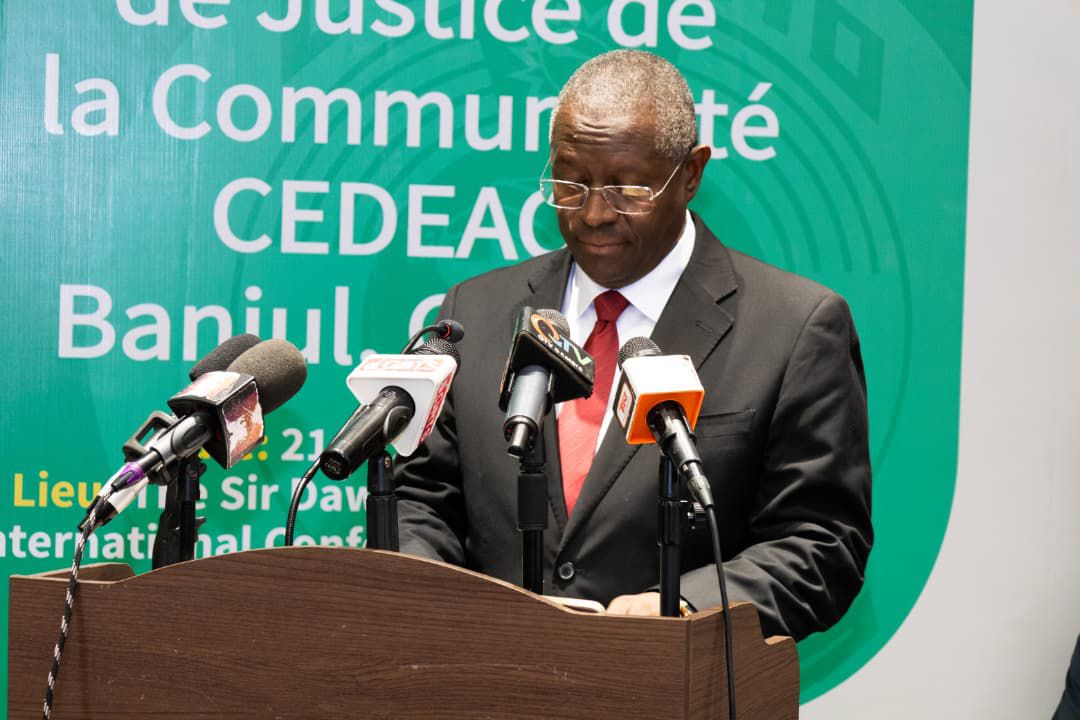
The President of the ECOWAS Court of Justice, Justice Ricardo Cláudio Monteiro Gonçalves, has urged Gambian lawyers, judges, academics, and law students to play a more active role in the regional court, emphasizing that its effectiveness depends on the West African legal community’s strong engagement.
Speaking at a sensitization event held on Thursday, 23 April 2026, at the Sir Dawda Kairaba International Conference Center in Bijilo, Justice Gonçalves described the Court not as a distant institution in Abuja but as a shared legal resource that belongs to the people and legal practitioners of the region.
“This Court belongs to you as much as it belongs to the peoples of West Africa,” he told participants. “Regional justice can only be effective if it is understood, used, and supported by those it is designed to serve.”
The President highlighted common procedural pitfalls that lead to dismissals or delays of cases, including missed filing deadlines, poorly drafted claims, incorrect identification of defendants, and inadequate evidence. He stressed that strict adherence to the Court’s Rules of Procedure is not a barrier but a guarantee of fairness, consistency, and legal certainty.
Justice Gonçalves also clarified the Court’s jurisdiction, noting that it hears cases only against ECOWAS member states for violations attributable to them. It does not entertain suits against individuals, private companies, or non-state actors.
He encouraged greater use of the Court’s electronic filing system, which allows lawyers to submit documents, track cases, and receive notifications online 24 hours a day, reducing the need for costly travel to Abuja. Virtual participation in hearings has also been introduced alongside physical sessions.
President of the Gambia Bar Association, Neneh M.C. Cham, welcomed the initiative, describing it as a vital step in bridging the gap between the Court and national legal practitioners. She noted that since the Court expanded its jurisdiction in 2005 to include human rights cases, such matters now dominate its docket. Cham pointed out that Gambians have already secured landmark rulings from the Court and announced plans for a legal aid program to help vulnerable citizens access regional justice.
Professor Olaolu S. Opadere, Dean of the Faculty of Law at the University of The Gambia, raised concerns about enforcement, estimating that only about 20 percent of the Court’s judgments are implemented by member states.
He warned that weak compliance threatens the Court’s credibility and called for a stronger enforcement mechanism and better coordination between national authorities and ECOWAS institutions.
Chief Registrar of the ECOWAS Court, Yaouza Ouro-Sama said public awareness of the Court remains low despite its growing body of case law. He explained that the sensitization program targets lawyers, judges, academics, civil society, and students to help close this gap.
He clarified that the ECOWAS Court complements rather than competes with national courts and does not serve as an appellate body; rather, it offers a regional avenue when domestic remedies fall short.
The event underscored growing efforts to make the ECOWAS Court more accessible and relevant to ordinary citizens across West Africa.