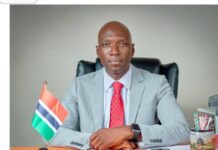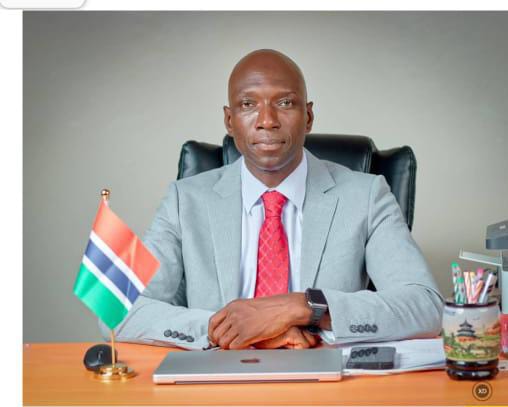
Gambia is facing simultaneous electricity shortages and chronic food insecurity due to excessive reliance on imports, opposition leader and economist Dr. Ousman Gajigo has warned, accusing the government of neglecting long-term domestic solutions in favor of short-term political optics.
In a statement, Dr. Gajigo described the severe power outages over the past weeks as a direct result of the government’s failure to invest in local electricity generation. Households and businesses have endured prolonged blackouts, leading to massive spoilage of perishable goods, soaring operational costs, reduced production, and rising unemployment. “Overall economic output has declined, while unemployment and prices will undoubtedly rise,” he said.
The root problem, according to the opposition economist, lies in the country’s heavy dependence on imported electricity. “The government operated on the assumption that the country could import as much electricity as needed at any time,” Dr. Gajigo noted. “Unfortunately, neighboring countries do not always have surplus energy, and global shocks can affect supply, leaving The Gambia highly vulnerable.”
He drew a direct parallel with the agricultural sector, where Gambia imports approximately 90% of its rice—the nation’s staple food—despite possessing the land and climate to achieve full self-sufficiency. “The Gambia has the lowest rice productivity in West Africa,” he lamented, adding that returns to farmers have stagnated while government efforts have focused on high-visibility distribution of tractors rather than essential land development and irrigation.
Dr. Gajigo criticized the current administration’s handling of more than $200 million in development partner assistance for agriculture over the past decade. “There is little to show for it,” he said. “Some of these funds have been lost to corruption and self-dealing.” He cited an African Development Bank rice cultivation project that allegedly benefited the president’s associates instead of farmers in the Upper River Region (URR) and Central River Region (CRR).
The economist highlighted external risks in rice imports, particularly from India, including unpredictable weather, geopolitical tensions in the Middle East, and potential changes in Indian export policies. “All these factors lie beyond the control of the Gambian government or people, yet all of them directly affect the availability of rice in this country,” he warned.
Dr. Gajigo acknowledged that challenges in energy and agriculture predate the current government but rejected this as justification for inaction after a full decade in power. “The failures of earlier governments do not justify the inaction of the current one,” he stated.
He emphasized that without progress in agriculture and reliable energy, Gambia cannot achieve the structural economic transformation it desperately needs. The economy remains trapped in low-productivity agriculture and services, lacking industry and diversification. “Gains in agricultural productivity are needed to enable low-level processing, which in turn lays the groundwork for manufacturing,” he explained. Reliable energy is equally critical to attracting foreign investment, which is essential for industrial growth.
Dr. Gajigo called for clear policy shifts: prioritizing domestic power generation and heavy public investment in irrigation and land development for key cereals, especially rice. Such measures, he argued, would stimulate local economic activity, create jobs, reduce dependence on imports, lower living costs, and shield the country from external shocks.
As the 2026 rainy season begins, Dr. Gajigo urged all Gambians to reflect on the government’s shortcomings in addressing these fundamental needs. “Few things matter more than food security and reliable energy,” he concluded.
The statement comes amid growing public frustration over persistent power cuts and high food prices, issues that continue to dominate national discourse as the country grapples with broader economic challenges.