By Fatou Dahaba
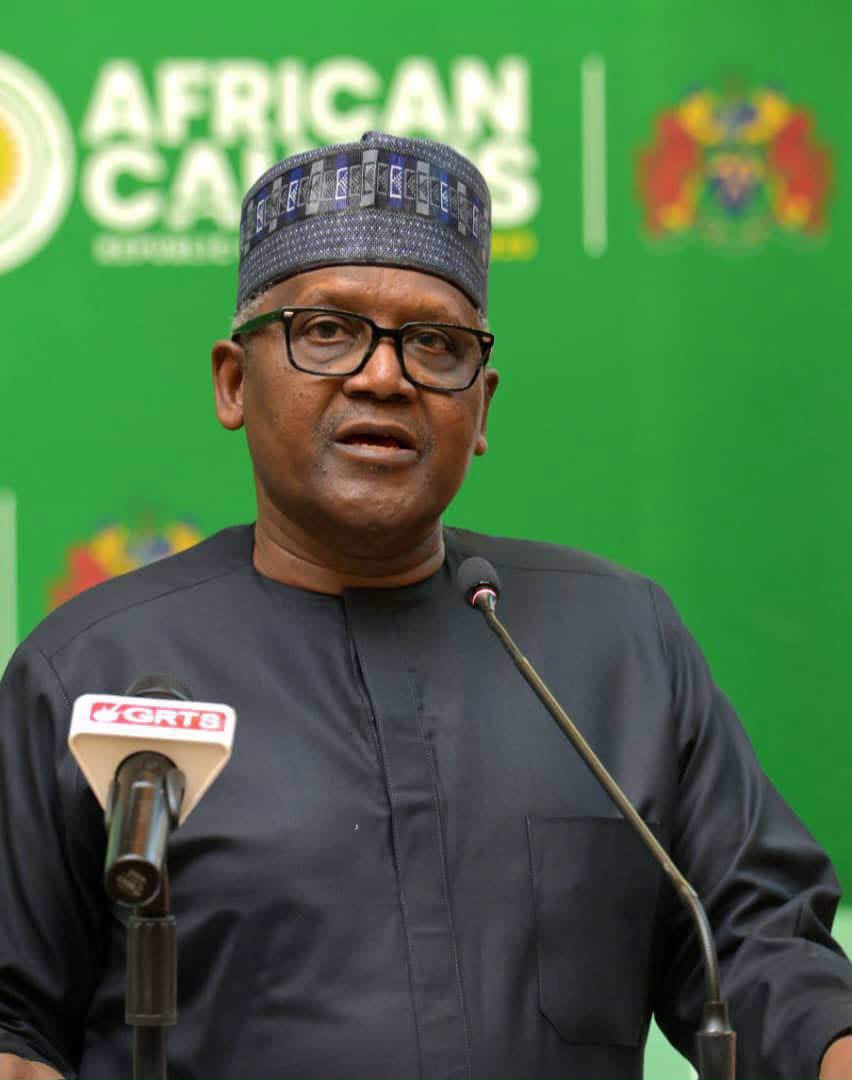
African industrialist and the continent’s richest man, Aliko Dangote, has issued a stark warning to African leaders: the continent must pursue urgent and deliberate industrialization or risk being condemned to a permanent role as a supplier of raw materials in the global economy.
Speaking at a high-level Africa Caucus meeting in Banjul on Tuesday, attended by policymakers and development partners, Dangote emphasized that no country has achieved high-income status in modern history without transforming its economy through industrialization.
“No country in modern economic history has achieved a high-income status without industrialization. Not one,” he declared. “Every economy that has escaped poverty at scale did so through a deliberate process of industrial transformation.”
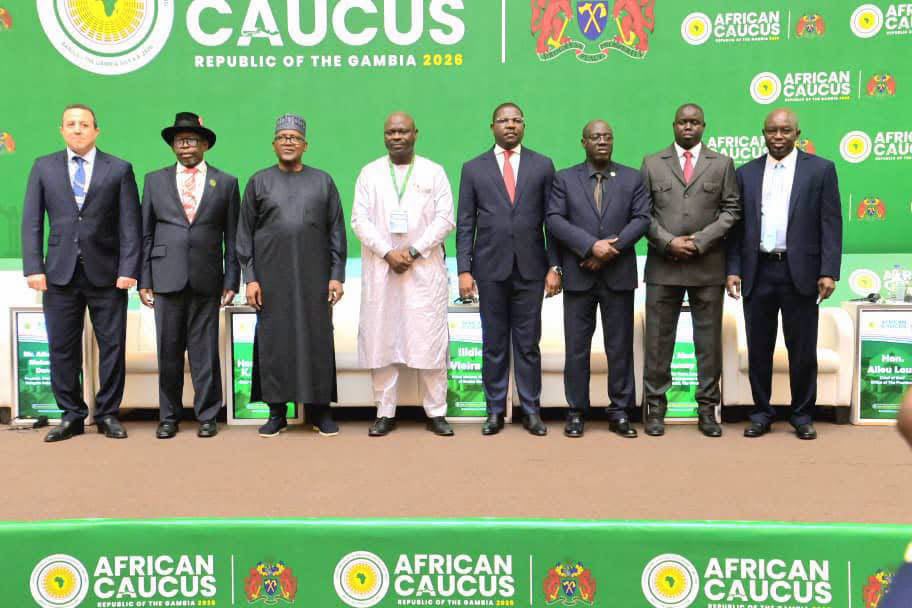
Dangote, Africa’s richest man and founder of the Dangote Group, positioned industrialization as the cornerstone of the continent’s economic strategy. He argued that it is essential for job creation, productivity growth, tax base expansion, and long-term social stability.
“Industrialization has historically been the bridge between abundance of natural resources and abundance of prosperity,” he said. “Growth derives solely from commodities that can raise incomes temporarily, but industrialization creates growth permanently.”
The billionaire highlighted a glaring paradox: Africa represents nearly 18% of the world’s population, holds about 30% of global mineral reserves, and 60% of the world’s uncultivated arable land, yet remains the least industrialized region. Its share of global manufacturing value-added is below 2%, while over 70% of its exports consist of primary commodities and raw materials.
As a result, the continent loses an estimated $40 to $50 billion annually by exporting raw goods that are processed abroad and imported back at much higher prices.
With Africa’s population projected to reach 2.5 billion by 2050 — creating the world’s largest workforce — Dangote described industrialization as an urgent imperative rather than an option.
“The choice before us is therefore not whether Africa industrializes, but whether Africa industrializes deliberately and collectively or remains a supplier of raw materials in a rapidly changing world economy,” he stated.
He called industrialization “perhaps the most effective anti-poverty program ever invented,” noting that manufacturing jobs generate higher productivity than traditional agriculture and stimulate employment across multiple sectors.
Dangote also stressed the need for deeper regional integration to overcome fragmented markets, tariff barriers, inconsistent regulations, and poor infrastructure. He lamented that Africa trades more with Europe, Asia, and North America than with itself.
He endorsed the African Continental Free Trade Area (AfCFTA) as a landmark initiative but cautioned that trade liberalization alone is insufficient. “Trade agreements do not create industries. Industries create trade,” he said. “The objective must therefore be to utilize AfCFTA as an industrialization platform.”
The entrepreneur advocated building regional value chains in sectors where Africa has comparative advantage, such as agriculture and food processing, fertilizers, pharmaceuticals, textiles, steel, automobiles, cement, battery minerals, and clean energy.
Drawing on his own conglomerate’s success, Dangote cited investments in cement, fertilizer, petrochemicals, sugar, and the landmark $20 billion Lekki refinery and petrochemical complex in Nigeria as proof that large-scale industrial projects can thrive on the continent.
He urged African entrepreneurs to invest at home rather than sending capital abroad, arguing that local leadership is key to attracting foreign investment. “Nobody will come on their own to invest in Africa unless we Africans lead,” he said.
Dangote called for improved infrastructure, policy coordination, long-term financing through domestic savings, such as pension funds, and stronger support from institutions such as the World Bank, the IMF, and the African Development Bank.
He also criticized restrictions on movement within Africa, comparing the ease of travel with a British passport to the barriers Africans face.
In closing, Dangote proposed an “African Industrialization Compact 2035” to unite governments, private sector, and development partners in measurable actions.
He framed industrialization not merely as an economic goal but as “an agenda for our dignity… sovereignty… and shared prosperity.”