By: Alieu Ceesay
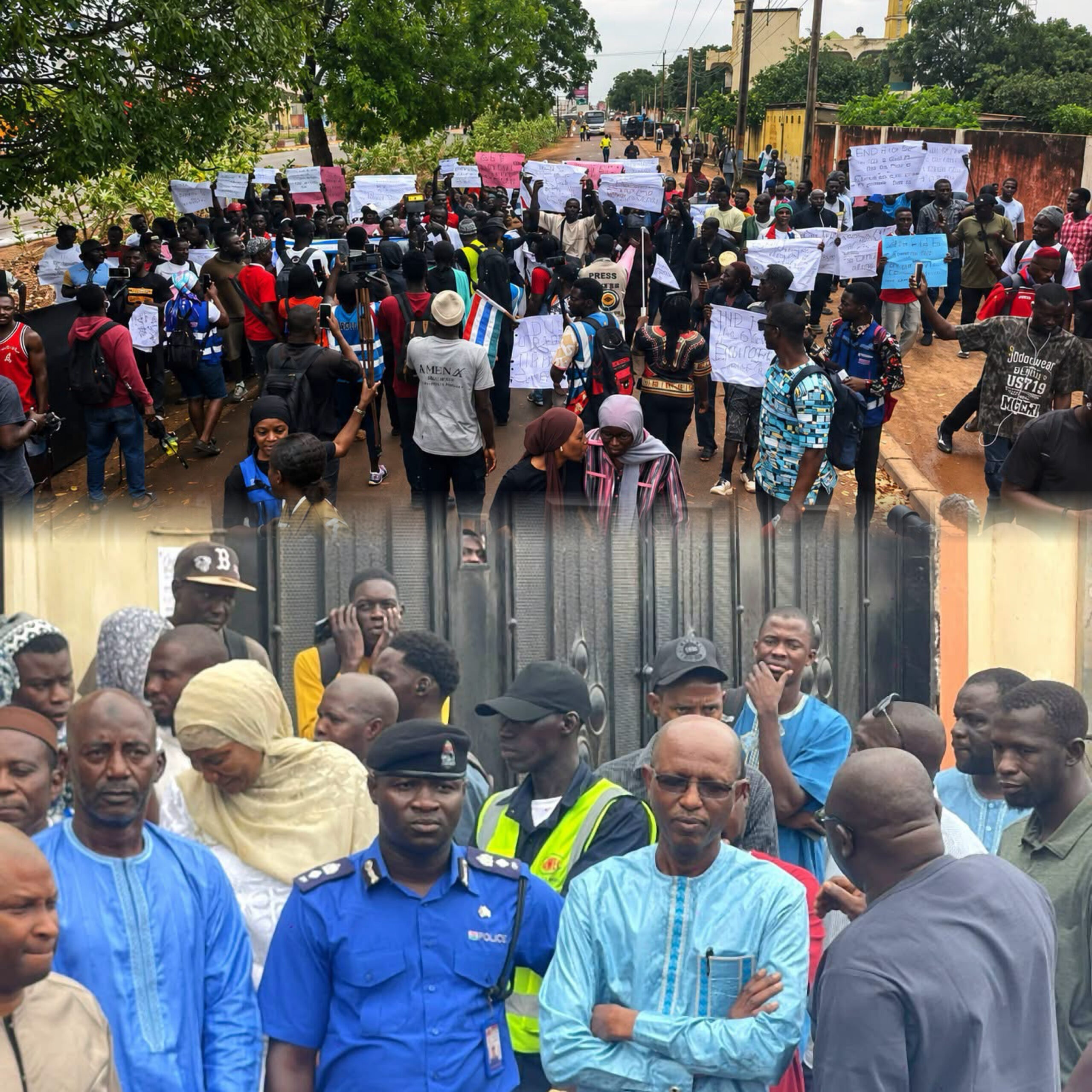
Despite heavy rain, frustrated Gambians took to the streets on Friday to protest persistent power outages and water shortages, as the civil society group Gambians Against Looted Assets (GALA) delivered a strongly worded petition to the National Water and Electricity Company (NAWEC), giving the utility just ten days to restore reliable services or face further action.
The protests highlighted growing public anger over daily hardships caused by frequent blackouts and water supply interruptions. Many residents say the disruptions have driven up living costs, disrupted businesses, and severely affected hospitals, schools, and households across the country.
In the petition addressed to NAWEC’s Managing Director Galo Saidy, GALA expressed “profound concern and outrage” on behalf of ordinary Gambians. “For far too long, Gambians have endured recurring blackouts, water shortages, voltage fluctuations, and service disruptions that have crippled homes, businesses, hospitals, schools, public institutions, and entire communities,” the document stated.
The group noted that recent declines in electricity supply have directly worsened water production and distribution, compounding the crisis nationwide. GALA insisted that access to electricity and clean water must be treated as fundamental rights rather than privileges.
“Access to electricity and clean water is not a privilege. It is a basic necessity and an essential public service,” the petition emphasized.
Despite substantial investments in the energy sector from 2017 to 2026 — including billions of dalasis in public funds and major donor-supported projects — reliable service remains elusive. GALA argued that the problems stem not from lack of funding but from deeper institutional failures.
“Rather, the evidence points to persistent governance failures, poor planning, weak management, lack of accountability, and recurring concerns regarding financial management and operational efficiency,” the group declared. The petition referenced audit reports, parliamentary debates, investigative findings, and public inquiries that have repeatedly flagged issues in procurement, project execution, and overall performance at NAWEC.
As a state-owned enterprise, NAWEC has a constitutional and legal duty to manage public resources responsibly and deliver essential services, GALA contended. The group framed the ultimatum as part of a broader protest against deteriorating utility performance.
“Accordingly, GALA hereby issues a Ten (10) Day Ultimatum to NAWEC to take all necessary measures to restore and normalize reliable electricity and water supply across The Gambia,” the petition read.
GALA made clear it is no longer willing to accept explanations or future promises. “We are not seeking further promises, excuses, timelines, or public relations statements. We are demanding tangible action and measurable results.”
The organization warned that if NAWEC fails to show substantial improvements within the ten days, it will pursue all lawful and constitutional avenues to hold the utility and responsible authorities accountable.
The petition concluded with a blunt rallying cry: “Restore Electricity. Restore Water. Ten Days. No Excuses. No Delays.”
GALA spokesperson Omar Saibo Camara has officially submitted a petition to NAWEC Managing Director Galo Saidy and Abdoulie Jallow, the Permanent Secretary at the Ministry of Energy. The petition includes a 10-day ultimatum, demanding urgent action to resolve the ongoing electricity crisis.
The development comes amid mounting public pressure on the utility company, which has struggled for years to provide consistent power and water despite ongoing reforms and international support. Many Gambians hope the ultimatum will finally force meaningful change, though others remain skeptical given past unfulfilled commitments.
As the ten-day countdown begins, all eyes are on NAWEC’s response and whether tangible improvements can be delivered before public frustration boils over further.